Types of Acrylic Flooring and Their Uses
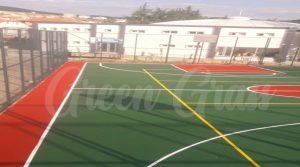
Acrylic courts are the official international court for tennis courts. Acrylic flooring can also be used for many other sports, such as football fields, running tracks, and basketball. Acrylic floors are among the best court floors used worldwide.
They facilitate ease of movement and reduce player injuries due to their softness and flexibility. They are also characterized by their high quality and long lifespan compared to other types of sports court floors.
Acrylic courts are known for being the first official court for creating enjoyable tennis courts, officially approved by the Football Association. However, this does not negate the advantages and flexibility of acrylic flooring, which allows it to be used in the construction of a number of other sports fields, including football, volleyball, and basketball, in addition to running tracks, horse stables, and public parks.
Types of Acrylic Flooring
Acrylic floors are characterized by durability and flexibility, and are available in a variety of types suitable for various uses, such as playgrounds, commercial spaces, and homes. They are easy to maintain and offer a variety of designs to meet all needs. Here are the types of acrylic sports court floors in detail:
1- Hard Acrylic Flooring
• This is the most common type of acrylic in Egypt and the least expensive. It is classified as ITF4 by the International Tennis Federation. These courts are played on medium to high-quality, economical courts.
• This system does not contain a lining layer, yet it has the appearance and durability of surfaces with lining layers. It is ideal for indoor and outdoor halls such as tennis, basketball, volleyball, and multi-purpose courts.
2- Cushioned Acrylic Flooring
• These are acrylic layers containing a lining of rubber granules mixed with an acrylic layer. They provide comfort, flexibility, and shock absorption for players. They are classified as ITF3 by the International Tennis Federation.
• Cushioned acrylic floors require no maintenance after any injuries during play. High elasticity and absorbency are the technical specifications for this type of acrylic flooring. It is widely used in indoor and outdoor multi-purpose courts, tennis courts, handball courts, and basketball courts.
3- Mat Acrylic
• It is a pre-fabricated rubber flooring in the form of strips covered with a layer of acrylic. This type is characterized by its longevity and the highest shock absorption for players. It is classified by the International Tennis Federation as ITF3.
• This type of surface is considered the fastest and best type of acrylic flooring, as it combines high-quality manufactured rubber strips and acrylic coating, resulting in a flexible surface. It is also long-lasting and provides maximum comfort and ball stability. It is widely used in indoor and outdoor courts, such as multi-purpose courts, tennis courts, handball courts, and basketball courts. It is available in rolls or layers.
Therefore, acrylic flooring is an ideal choice due to its durability and ease of maintenance. It is one of the strongest types of acrylic. If you are looking for the best solutions, Greengrass offers a variety of acrylic flooring to meet your needs with the highest quality and performance.
Acrylic Court Flooring Prices
Acrylic flooring prices vary depending on the type, thickness, and quality of the acrylic flooring, as well as factors related to the location where it will be installed. In general, acrylic court flooring prices vary depending on the use, whether for playgrounds, commercial spaces, or residential areas. These prices are also affected by local factors and market changes. To obtain accurate and up-to-date prices, it is recommended to contact Greengrass to inquire about current prices and special offers that may suit your needs.
How to Build Acrylic Flooring with Greengrass
Acrylic flooring can be used to build many different court floors, such as football, basketball, and volleyball. However, it is internationally classified for tennis court floors. Acrylic courts consist of a concrete floor layer and are then… It is manufactured to special specifications for the acrylic coating to be applied, then prepared for continuous use and consumption. Here are the detailed steps for floor preparation:
1. Surface Preparation: The first step is to thoroughly clean the underlying surface to remove any dirt, dust, or sealants. Specialized cleaning equipment, such as high-pressure cleaners, may be used to ensure all residues are removed. Greengrass then cleans the surface and inspects it thoroughly. Any cracks or holes are present, and they are treated with special filling materials to ensure a completely level surface.
2. Surface Drying and Ventilation: The surface must be completely dry before applying acrylic flooring. Therefore, ensure that the humidity does not exceed the permissible level, as excessive humidity can affect the adhesion of the acrylic flooring.
3. Surface Priming and Treatment: In some cases, the underlying surface may require pretreatment, such as priming with polyurethane or a primer. This helps enhance the adhesion of the acrylic layer to the surface.
4. Initial Basecoat Preparation: After the surface has been treated, Greengrass begins applying the acrylic basecoat (known as a “basecoat”). (Monokote) using a precise method to ensure even distribution and proper expansion of the layer. A special machine is used to ensure uniform acrylic layer thickness across the entire area.
5. Preparing the top coat: After the base coat has dried, the acrylic top coat is applied using professional tools. Special acrylic coatings are used that offer greater resistance to scratches and abrasion, which is especially essential for high-traffic areas such as the home.